
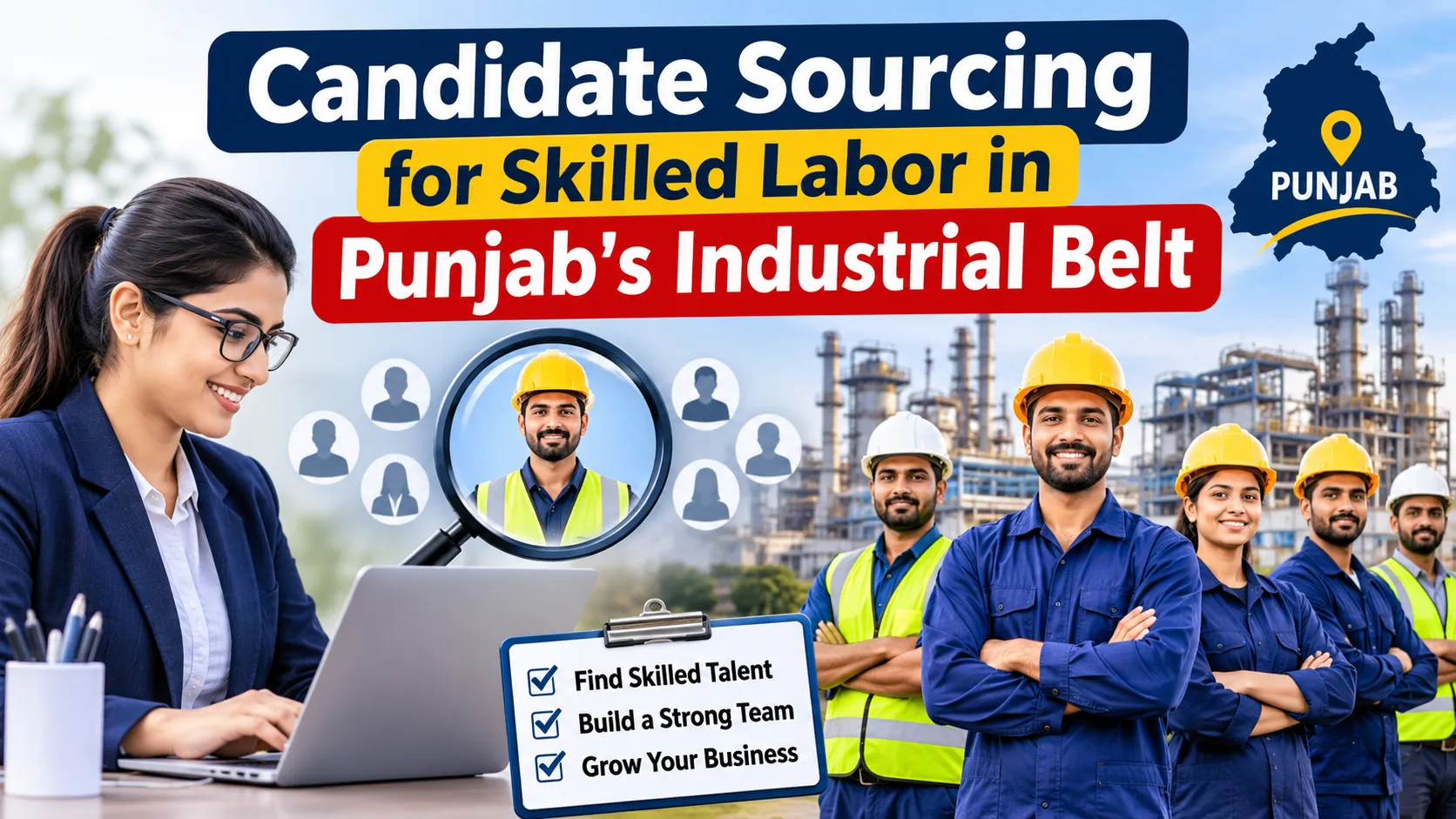
Punjab’s manufacturing corridor runs on machinists, welders, CNC operators, line supervisors. People who rarely show up in a résumé database. Plants in Ludhiana, Jalandhar, Mohali fight over the same shrinking pool every production cycle, and most HR teams still treat it as a hiring problem. It isn’t. It’s a supply chain problem that’s been mislabeled for a decade.
The Root Cause of Skilled Labor Shortfalls in Punjab’s Industrial Belt
The scarcity didn’t appear overnight. Punjab’s industrial clusters grew faster than its vocational training system could keep pace, and that gap between machine capacity and trained operators hasn’t closed since. Candidate sourcing skilled labor Punjab industrial belt work now competes with Gulf-bound migration, interstate wage arbitrage, and ITI graduates who’d rather drive for an app than stand at a lathe. Demand resets every quarter. Supply barely moves.
A bicycle-parts manufacturer near Ludhiana found this out the hard way during peak export season. Two of its six CNC operators quit in the same week — poached by a unit three kilometers down the road offering 12% more. No bench candidates waiting. No pipeline. Seven days before a replacement could even sit for an interview, and the export order shipped late.
- Attrition in CNC and welding roles here often runs 18-22% a year.
- Replacing a certified operator can take over two weeks when sourcing only starts after someone quits.
- A lot of that churn is just local poaching between plants a few kilometers apart.
Reactive hiring guarantees a permanent shortfall. Skilled labor sourcing Punjab plants rely on works only when it’s a standing function, not a fire drill.
Why Walk-In Hiring and Classifieds Fail Manufacturing Plants
Gate walk-ins and newspaper ads still dominate blue-collar recruiting across the belt, mostly out of habit. These channels bring volume, not verification. Run a blue collar hiring Punjab drive through unstructured walk-ins and you’ll get headcount fast — quality is a different story, and it usually surfaces weeks later on the shop floor, not in the interview room.
A Mohali auto-ancillary unit needed 40 welders ahead of a new contract. Classifieds went out, gates opened for three days, and candidates showed up by the dozen. A month later, 27 of those hires were gone. Shift terms weren’t clear going in. Skill levels didn’t match what the job actually required.
- No standardized skill test before someone’s placed on a live line.
- No backup bench, so every resignation turns into an emergency.
- Shift mismatches get discovered after hiring, never before.
A hiring agency in Punjab running proper verification catches these problems before day one. Not after the third week of a contract.
Building a Structured Sourcing Pipeline for Factory Floors
A pipeline that actually works connects three things: local ITI networks, referral chains from current operators, and a maintained database sorted by skill tier. Hardly any plant in this belt has all three built. Most lean on whoever’s available the day a vacancy opens — which is exactly the gap a serious recruitment agency in Punjab is built to close.
A Jalandhar sports-goods exporter tried something different. Two district ITI tie-ups, plus a referral bonus for existing staff. Within two quarters, 60% of new hires came through those two channels instead of the open market. Ninety-day retention went up. Time-to-fill for mid-skill roles dropped by close to a third.
- Candidate sourcing skilled labor Punjab industrial belt programs that tier candidates by certification level cut down on bad placements.
- Trial shifts — a paid half-day before full onboarding — reduce early dropouts noticeably.
- ITI partnerships renew themselves every batch cycle, unlike a one-off hiring push.
Structure beats scramble, every time. That’s the whole difference between plants with stable headcount and plants that are always one resignation behind.
The Hidden Cost of Getting Sourcing Wrong
An idle workstation costs money by the hour, not by the day. Delayed sourcing isn’t just an HR headache — it eats margin directly, through idle machines, overtime to patch the gap, and penalty clauses when shipments slip. Skilled labor sourcing Punjab companies file under HR is, on the balance sheet, a production cost.
A textile unit in Patiala lost an entire line for 11 days after two operators walked out mid-order with no notice. Overtime for the remaining crew spiked. The client invoked a late-delivery clause. A good chunk of that order’s margin was gone before the line even restarted.
- Idle loom or CNC time can bleed significant revenue per station, per day.
- Overtime to cover gaps usually costs more than keeping a pre-vetted bench on standby.
- Export penalty clauses often wipe out whatever was “saved” by hiring late.
Speed in sourcing is a financial safeguard, not a nice-to-have. Units that actually run the numbers tend to invest earlier.
A number of industrial units now benchmark their own hiring metrics against established players like T&A Solutions, which has a documented track record in recruitment across Punjab’s manufacturing and staffing space, just to see where their own gaps sit.
Where T&A Solutions Fits Into Punjab’s Industrial Hiring Map
T&A Solutions works within Punjab’s wider recruitment ecosystem, including industrial and blue-collar staffing. Firms weighing a hiring agency in Punjab for ongoing skilled-labor needs tend to compare service models on three things: how deep the verification goes, how wide the regional database reaches, and how fast turnaround is for shift-critical roles. Agencies with real local networks shrink the gap between an open vacancy and a verified hire — which matters most right when a plant can least afford to wait. For many units, it’s simply one reference point among several when sizing up their own sourcing process.
FAQs
- What makes blue collar hiring Punjab campaigns fail most often?
Unverified walk-in volume, no skill testing, unclear shift terms going in. Candidates accept the job without the full picture, then leave within weeks once reality doesn’t match expectation.
- How long should sourcing take for a certified machine operator in this belt?
With a standing pipeline, 5-7 days is realistic for mid-skill roles. Without one, it routinely runs past two weeks.
- Is a hiring agency in Punjab worth it for just one factory location?
If shift gaps or seasonal spikes keep recurring, usually yes. A verified channel tends to cost less than the idle-machine time and repeat hiring that comes from going without one.
- Can referral programs alone fix skilled labor shortages on factory floors?
They help, but they don’t scale on their own. Pair them with ITI partnerships and a tiered candidate database and the whole system gets a lot more durable.
